So, that's the simple rule- don't wast calories on something that's not worth it. If you are gifted a plate of goodies and they aren't simply divine, are they worth the calories they are costing you? If you feel bad about throwing away someone's hard work, just tuck it away out of sight for a week, then chuck it when feelings aren't so fresh. That is part of the plan- get those goodies OUT OF SIGHT. Better WASTED than on your WAISTLINE. And remember, ask yourself if it's worth it- if it is, enjoy!
Wednesday, December 28, 2011
Tip #26 Holiday Eating
So, that's the simple rule- don't wast calories on something that's not worth it. If you are gifted a plate of goodies and they aren't simply divine, are they worth the calories they are costing you? If you feel bad about throwing away someone's hard work, just tuck it away out of sight for a week, then chuck it when feelings aren't so fresh. That is part of the plan- get those goodies OUT OF SIGHT. Better WASTED than on your WAISTLINE. And remember, ask yourself if it's worth it- if it is, enjoy!

Sunday, December 18, 2011
Follow up: eggs/day
So, in the last post, I referenced the Mayo Clinic article on eggs and cholesterol. It said that in the study they ate 7 eggs/day without it affecting their cholesterol. A couple of you caught that because it seemed like a ton of eggs! The recommendation used to be 3 eggs a WEEK. After hunting around, all I can pretty much find is that the recommended intake of cholesterol shouldn't exceed 300 milligrams/day (we don't actually need any, so you can have as little as you like . . . ) and that eggs contain about 213 mg/egg yolk. So one egg a day is going to pretty much use 2/3 or more of the recommended amount. So even if the study found there weren't harmful affects from eating 7 a day, I think the basic recommendation would be 1 per day (although I never did find it in no uncertain terms and didn't access the original article about the study).
Sunday, December 4, 2011
Tip #25 Eggs

So, cholesterol- right? I never told people to stop eating eggs. I might have told them to cut back, but never avoid them completely. Here is why. Blood cholesterol levels are usually more affected by your intake of saturated fat, exercise and your HDL (or good cholesterol) levels than it is by dietary cholesterol. It's true- your body will make all the cholesterol it needs for cell functioning, so you don't need to eat ANY. But it's also true that only a small % of the population is drastically affected by their dietary intake of cholesterol, it's usually saturated fat and exercise that play a bigger role. Here is a part of a WebMD article that I just read about dietary cholesterol- it repeats some of what I just wrote, but oh well. By the way, I trust WebMD with my health and nutrition questions. HERE is the link to the whole article if you want to read it.
Cholesterol and the Great Egg Debate
"One source of confusion has long been eggs. A typical egg contains about 200 milligrams of cholesterol, but only 1.5 grams of saturated fat. When researchers first linked high blood cholesterol levels to heart disease, eggs got a bad rap.
But there's never been good evidence that eggs are a major factor in high blood cholesterol levels or a contributing cause of heart disease.
In fact, when researchers at Harvard Medical School analyzed data from almost 120,000 men and women, they found that eating the equivalent of an egg a day did not increase the risk of heart disease or stroke. A more recent Harvard Medical School study, published in 2008, also found that otherwise healthy men could eat up to seven eggs a day with little risk. The only danger showed up in men with diabetes, which is known to increase heart disease risk.
Indeed, studies suggest that only about 30% of people are particularly susceptible to the effects of dietary cholesterol on blood cholesterol levels.
And overall, the effects of dietary cholesterol are relatively small compared with saturated fat and trans fats.
In a review of studies in which volunteers were fed eggs, researchers found that lowering the amount of dietary cholesterol by 100 milligrams a day resulted in only a 1% reduction in blood cholesterol levels. Replacing saturated fat with unsaturated fat had a much more beneficial effect on cholesterol."
Having said all that- I still cut out the occasional egg yolk. I like it better that way anyway- we have scrambled eggs a lot and I think they are lighter and a better texture when I take out one yolk for every 4 or 5 eggs I use. Not too many- too many good nutrients in those yolks!
~Here's to Healthy Eating
Sunday, November 20, 2011
Tip #24 Making breakfast ahead of time

Whole Wheat Blender Pancakes
1 cup milk
1 cup uncooked whole wheat
Blend in blender for 4 minutes
Add:
1/2 cup milk
Blend for another 4 minutes
Add:
2 eggs
1/2 cup oil (try using less)
3 teaspoons baking powder
2 tablespoons honey or sugar
½ teaspoon salt
Blend remaining ingredients and cook on hot griddle- batter will be thin.
I also made the baked oatmeal on a weekend night and we enjoyed heating bowls of that up through the week. I made the recipe with whole oats as I planned and it turned out fine (I made 1 and 1/2 times the recipe for a full 9 x 13). I don't think instant oats are needed there. I have also gotten bags of whole wheat English Muffins at the bakery outlets and made lots of egg/cheese (sometimes ham) sandwiches on weekends and wrapped them and froze them to be reheated individually. This can be tricky - when you reheat them sometimes the English Muffin can get tough. So I think letting it thaw first is probably the wisest decision. My mother in law made breakfast burritos for a reunion that we reheated in the oven- they were wrapped in foil. This works really well compared to the microwave. My sister makes a huge pot of steel cut oats with a lot of goodies in it- apples, nuts, etc and she and hubby re-warm it by the bowlful throughout the week. All of these options are great ideas! Just eat breakfast, whatever you prefer to do.
~Here's to Healthy Eating
I also made the baked oatmeal on a weekend night and we enjoyed heating bowls of that up through the week. I made the recipe with whole oats as I planned and it turned out fine (I made 1 and 1/2 times the recipe for a full 9 x 13). I don't think instant oats are needed there. I have also gotten bags of whole wheat English Muffins at the bakery outlets and made lots of egg/cheese (sometimes ham) sandwiches on weekends and wrapped them and froze them to be reheated individually. This can be tricky - when you reheat them sometimes the English Muffin can get tough. So I think letting it thaw first is probably the wisest decision. My mother in law made breakfast burritos for a reunion that we reheated in the oven- they were wrapped in foil. This works really well compared to the microwave. My sister makes a huge pot of steel cut oats with a lot of goodies in it- apples, nuts, etc and she and hubby re-warm it by the bowlful throughout the week. All of these options are great ideas! Just eat breakfast, whatever you prefer to do.
~Here's to Healthy Eating
Saturday, November 19, 2011
Tip #23 Take your time
But I have noticed that all this hurrying leads to hiccups, upset tummies and I hardly chew my food. This is bad- very bad. One of the best things you can do for yourself health-wise is take your time eating and enjoy your meal. Chew thoroughly and make sure you are "present" while eating. Don't try and do other activities, your mind just doesn't process the meal the same way and you come away less satisfied. I heard a story on the radio about people who follow a raw food diet. They don't eat anything that's been cooked. Think about that one. Grains? They soak them and chew, chew, chew. One raw food dieter said that is one of the best things about the diet- you have to chew the heck out of your food. You really have to appreciate it's flavors, textures and take your time to eat. You have all heard of other cultures and how they take their time to eat: Japan and all those small dishes of different items plus using chopsticks usually = taking smaller bites. European culture (especially French) who take a long time to enjoy many courses of foods. This is far healthier than our uber fast lunches at the desk we are notorious for. So, take a little more time. As with anything that comes down to scheduling, it's all about priorities. You gotta feel it's important enough to start a little earlier and enjoy your meal.
~Here's to Healthy Eating
Sunday, November 13, 2011
Split Pea Soup and Food Science Sunday
Yesterday I made split pea soup. It was such a grey, miserable day in Seattle we also had soup for lunch. It was soup day.
My mom gave me this recipe, and it is delicious. Here it is:

Here is what I changed: I didn't have celery (I am not in love with celery anyway), so I added some celery salt, some celery leaves and diced up 2 potatoes to make up some of the bulk (plus I love potatoes). I boiled the split peas with the ham bone too long and my split peas were nearing oblivion, and I like a little texture to my split pea soup, so I turned off the heat and removed the pan from the unit. I cooked my diced veggies in a different pan by themselves. I used a large stainless steel shallow pot with lid, I sauted the onions first, added the carrots and potatoes, a little water and put the lid on to let them soften up. This will cook up your veggies nice a fast- the wider the pan, the better. Watch for sticking and scorching. Within 10 minutes or so I had nice and soft veggies to add to my soup. The soup didn't have to cook anymore and my split peas still had a little lumpiness left, the way I like them. Here is another part of this tip- I have realized that my heavy bottomed stainless steel pots and pan keep my food really hot for a really long time. Although this is nice for some recipes, other foods it can ruin. I have learned the hard way I have to remove pastas and light sauces immediately from the pans or they will continue to cook, making them overdone and evaporating all the moisture. So watch that on your pans.
Stay tuned for more about breakfasts, reader suggestions and more tips to come. Now that every last apple is canned, I feel like a woman with a burden lifted off my shoulders!
~Here's to Healthy Eating
My mom gave me this recipe, and it is delicious. Here it is:
Split Pea Soup
8 cups water
3 14 oz. cans reduced
sodium chicken broth
1 lb. cooked boneless
ham chopped or ham bone with meat
4 ½ cups dry split
peas, rinsed and drained
3 bay leaves
¼ tsp. Dried
marjoram, crushed
¼ tsp. ground black
pepper
1 ½ cups chopped
carrots (3 medium)
1 ½ cups chopped
celery (3 medium)
1 ½ cups chopped
onion (2 medium)
salt and pepper to
taste
In a 7 – 8 quart Dutch oven combine water, broth, ham, split
peas, bay leaves, marjoram and peppr. Bring mixture to boiling, reduce heat.
Simmer covered 1 hour. Stirring occasionally. Uncover, stir in carrots, celery
and onions. Bring to boiling. Reducee heat. Simmer, covered for 20 – 25 minutes or until vegetables are
tender. Season to taste with salt and pepper. Remove bay leaves, discard. Stir
to combine. Serve immediately or cool 30 minutes.
To freeze divide cooled soup among three 2 quart freezer
containers. Cover, label and freeze up to 3 months.
To reheat frozen soup, dip the bottom of the
container in hot water for 5 minutes. Transfer frozen soup to a large saucepan.
Cook, covered, over medium low heat about 30 minutes or until heated through,
stirring occasionally. Makes 12 servings.Here is what I changed: I didn't have celery (I am not in love with celery anyway), so I added some celery salt, some celery leaves and diced up 2 potatoes to make up some of the bulk (plus I love potatoes). I boiled the split peas with the ham bone too long and my split peas were nearing oblivion, and I like a little texture to my split pea soup, so I turned off the heat and removed the pan from the unit. I cooked my diced veggies in a different pan by themselves. I used a large stainless steel shallow pot with lid, I sauted the onions first, added the carrots and potatoes, a little water and put the lid on to let them soften up. This will cook up your veggies nice a fast- the wider the pan, the better. Watch for sticking and scorching. Within 10 minutes or so I had nice and soft veggies to add to my soup. The soup didn't have to cook anymore and my split peas still had a little lumpiness left, the way I like them. Here is another part of this tip- I have realized that my heavy bottomed stainless steel pots and pan keep my food really hot for a really long time. Although this is nice for some recipes, other foods it can ruin. I have learned the hard way I have to remove pastas and light sauces immediately from the pans or they will continue to cook, making them overdone and evaporating all the moisture. So watch that on your pans.
Stay tuned for more about breakfasts, reader suggestions and more tips to come. Now that every last apple is canned, I feel like a woman with a burden lifted off my shoulders!
~Here's to Healthy Eating
Sunday, November 6, 2011
Tip #22 Overcoming an overcrowded oven
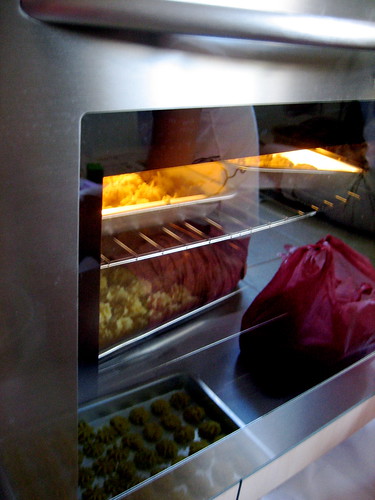
How did you fare over Halloween? Thanksgiving is right around the corner and parties are being planned as we speak. Here is a good tip for cooking for a crowd. Recently someone called with a question: she wanted to know if she had too much stuff in her oven and how it would affect her food. Everyone's oven is different, but generally speaking an overcrowded oven means 2 things. 1) It will take longer for your food to cook and 2) It will cook unevenly- you may have overdone spots and underdone spots. Most ovens rely on air to evenly distribute the heat. You should try and have at least 1-2 inches of space between pans and nothing should touch the oven walls. I have this problem when I roast vegetables. I usually want to roast more than one sheet of veggies at a time, i.e. the asparagus I want to roast won't all fit on one sheet. I use 2 racks and put one sheet on the far left and one on the far right and rotate them halfway through. It's a bit risky- sometimes the asparagus on the lower rack comes out more steamed than roasted, but I have had moderate success. If you are crowding more things into your oven than you think is probably wise, try lowering your heat 5-10 degrees, rotating and moving pans from high to low, back to front and left and right once or twice during cooking and give yourself more time to get everything done. Make sure the edge of the pan that was facing the middle now faces the outside when you move it. The outside cooks fastest. That brings me to another point: put your thickest cut meats at the edges of your pans, and thinner or smaller cuts in the middle.
Good luck!
~Here's to Healthy Eating
Subscribe to:
Posts (Atom)